
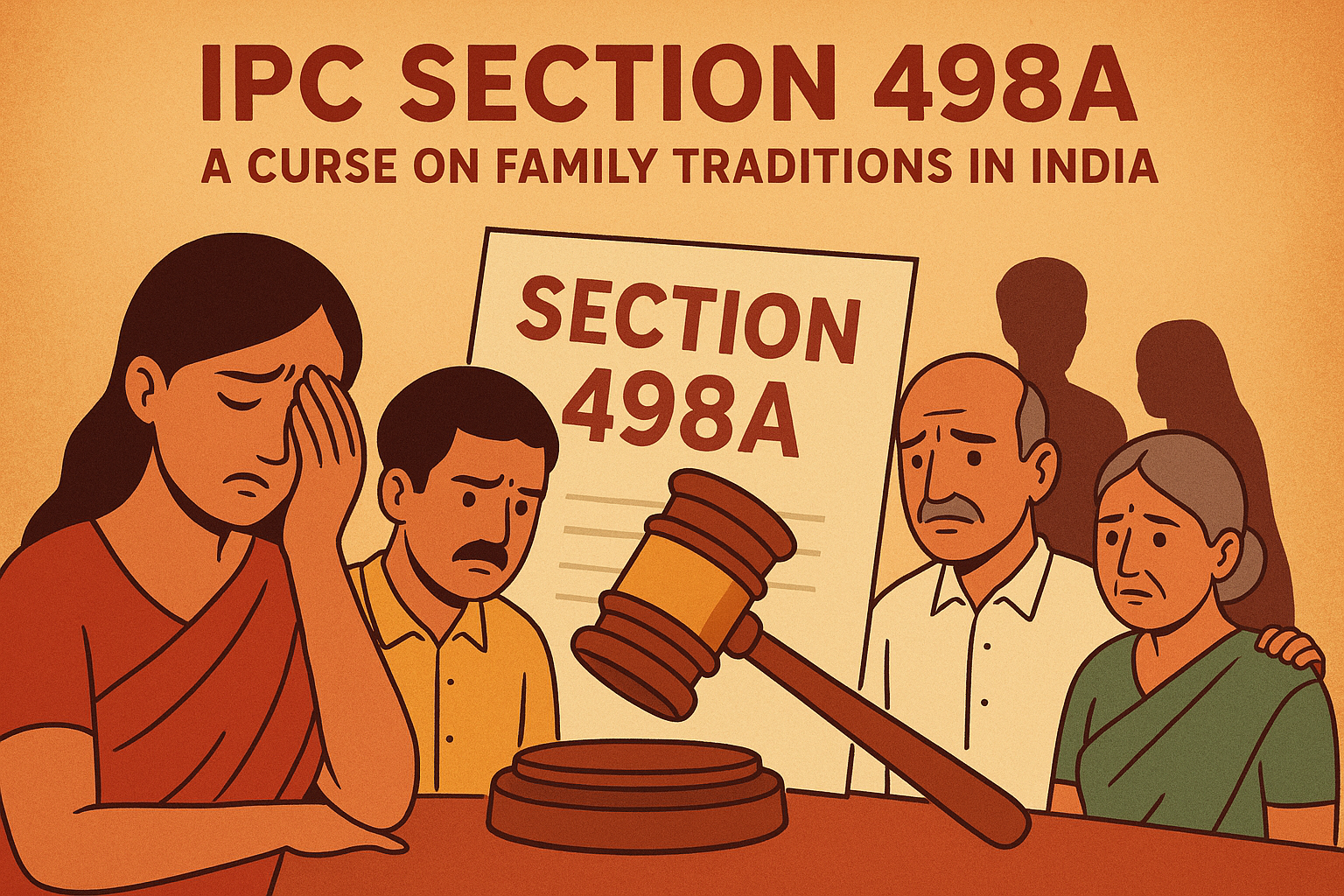

IPC 498A has become now a curse on family tradition. Indian families have long been built on the foundation of trust, sacrifice, and shared responsibility. Generations have grown up seeing marriages not merely as a union between two individuals, but as the coming together of families.
Yet, in the past few decades, this foundation has come under strain—largely due to the misuse of laws originally framed with noble intent. Among them, Section 498A of the Indian Penal Code (IPC) stands out as one of the most debated and misused provisions, often described as a curse on Indian family traditions.
Why is Section 498A IPC is a Curse?
Section 498A was introduced in 1983 with the stated objective of protecting married women from cruelty at the hands of their husbands and in-laws. However, the law is entirely one-sided, as it ignores the possibility of cruelty against men by their wives. Cruelty here includes harassment related to demands of money (dowry), emotional abuse, or physical harm.
The law made such acts a non-bailable and cognizable offence, giving women the right to seek immediate protection and justice. As the law is completely one-sided, it criminalizies being Men in the family.
What we believe that the intention of the law is in question. The law empowering women (bahu) effectively does so by suppressing men and entire families, holding them accountable merely on one-sided allegations.
The Dark Side – Misuse of Section 498A
The Law, instead of delivering justice, Section 498A has too often been misused as a weapon in marital disputes, turning family life into a battleground of legal harassment.
Courts, activists, and even government reports have acknowledged that false cases under Section 498A are rampant. The broad and stringent nature of the law has made it an easy tool for harassment:
- False Allegations
- Family-Wide Harassment
- Breakdown of Family Trust
Impact on Family Traditions
The misuse of Section 498A has deeply scarred the Indian social fabric:
Fear Over Togetherness: Traditional joint families have become wary of living together, fearing that one complaint could land everyone in jail.
Erosion of Respect for Elders: In-laws, particularly elderly parents, face humiliation and arrest despite their innocence, eroding the age-old respect between generations.
Loss of Trust in Marriage: Marriage, once considered a sacred bond, is increasingly being reduced to a legal contract overshadowed by mistrust.
Rising Male Suicides: Men, unable to bear the social stigma and legal harassment, are increasingly taking their own lives—a silent epidemic rarely spoken about.
Judicial Observations
Even the Supreme Court of India has repeatedly recognized the misuse of Section 498A. In landmark judgments, the Court has warned against treating every matrimonial dispute as cruelty and directed the need for safeguards before arrest. In 2014, the Court even remarked that this law had become a “weapon rather than a shield.”
The Way Forward
Balance is the key:
Gender-Neutral Laws: Matrimonial laws should protect all victims of abuse, irrespective of gender.
Strict Action Against False Cases: Filing false cases should invite legal consequences, including compensation to the falsely accused.
Stop Mediation with Litigation: Family disputes should first be addressed through counseling and mediation, preserving the sanctity of marriage before resorting to criminal law.
Awareness Campaigns: Society must be educated about the importance of both women’s safety and the rights of men and families.
29 Sep 2025